


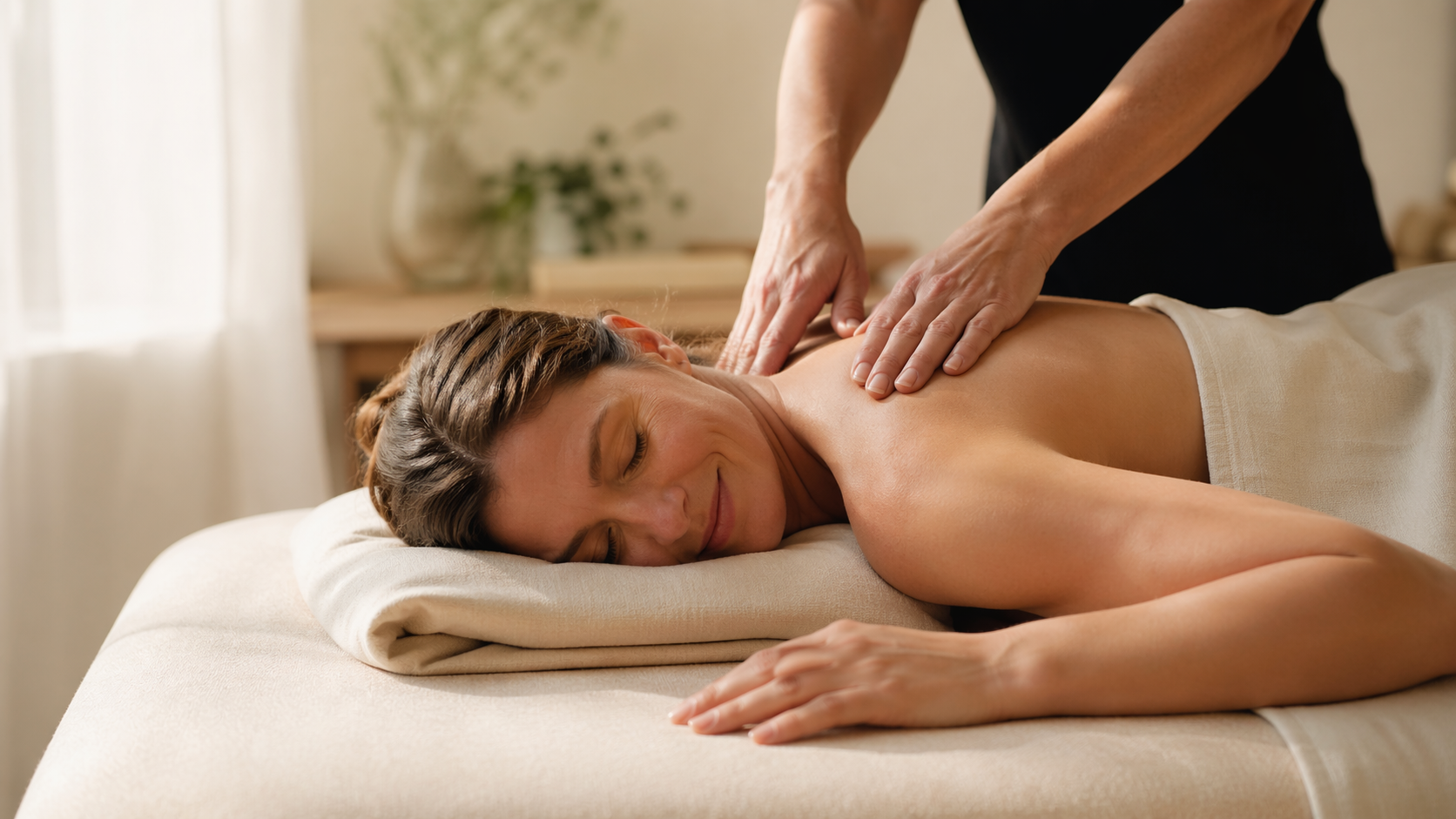
Many people still think of massage as something pleasant, something that feels good, relaxes you, and leaves you feeling a little lighter afterward. That is true, but it is not the whole picture. Because the body is made up not only of muscles, but of regulation as well. What matters is not only where a muscle is tight, but also what state the whole organism is in. How a person breathes. How much they live in a state of alertness. How deeply they sleep. How much they are able to let go of that inner holding pattern that so many people live in today.
That is why massage is not only about loosening a tense area. A good treatment affects the whole organism. Not only the muscles, but also that inner regulation which determines how much a person lives in tension and how capable they are of truly letting go.
Modern life often does not simply make a person tired. More often, it leaves them functioning in a constant state of readiness. They are paying attention, reacting, adapting, coping, making decisions, and meanwhile the body gradually becomes used to holding itself all the time. After a while, this state feels so natural that many people no longer even notice how rare true calm has become for them. In such moments, massage is not only a pleasant experience, but can also become a signal to the body: you do not need to defend yourself right now, you can let go a little.
That is why, for many people, something begins to change even in the first part of a treatment. The breath becomes deeper. The inner rush begins to settle. The shoulders stop holding so much. The jaw softens. The chest opens a little. Most people do not describe this in professional language. They simply say: it feels as if something dropped lower inside me. And in truth, that is a very precise way of putting it. In such moments, the organism can move closer to a calmer, more settled state.
Research has been trying for a long time to understand what lies behind this effect. In connection with massage, certain hormonal and nervous-system processes are often mentioned, and not without reason. Cortisol and oxytocin are the most commonly discussed, but other neurotransmitters may also be part of the picture, because they play a role in how we feel in our own bodies.
Many people know cortisol as the stress hormone. That is a simplification, but it is true that it plays an important role in the body’s stress response. During massage, cortisol levels may decrease, which means that the body’s stress-related load may lessen. This fits well with what many people experience in practice: after a treatment they feel quieter, less tense, less like they are still running in “operational mode.”
Oxytocin is often described as the hormone of trust, bonding, and safety. That too is a simplification, but it points in the right direction. Safe, calming touch may be accompanied by oxytocin release, and that can partly explain why a person may feel calmer, softer, and more deeply held after a good treatment.
Serotonin, dopamine, and endorphins are also frequently mentioned in this context, and they are likely part of what people experience during and after massage as well. These are the substances many associate with wellbeing, relief, and a certain sense of inner ease. It is not helpful to reduce massage to some kind of “happiness-hormone switch,” but it is entirely reasonable, and professionally sound, to say that treatment affects not only the muscles, but also the body’s overall state of regulation.
And perhaps this is where the heart of the matter lies. The most important question is not exactly which hormone is released and in what amount, but what the person actually experiences in their own body. Because what most people feel is very real. The inner noise becomes quieter. The breath becomes deeper. The holding begins to soften. Falling asleep in the evening may become easier. The chest feels less tight. It is as if, for a while, the body no longer wants to defend itself, but simply to rest.
In the Seishin approach, that is why I do not look at massage as mere muscular treatment. I see it more as bodily support that can help the organism come out of the constant inner strain in which so many people live today. Very often, the body is not tired because it is weak, but because it has been holding itself for too long. Because it has been living in readiness for too long. Because there has been too little real release for too long. In such moments, good massage is not only mechanical work, but also an invitation back toward a calmer state.
That is why many people do not speak in scientific terms after a treatment when they describe what happened to them. They do not say that their hormonal regulation probably changed. They say, instead, that things finally feel a little easier. That they seem able to breathe more deeply. That something inside them feels quieter. These are simple sentences, yet they often describe the essence more accurately than rushed biochemical explanations.
Massage, then, is not important only because it feels good. It is also important because it may help the organism let go of that constant tension so many people live in almost without noticing it. Hormones and neurotransmitters may indeed be part of that story. But the whole story is more human than that. It is about the body finally being given a chance not only to function, but to truly feel relief.
And that means far more than it may sound like at first.
Bágyok Károly
Seishin Grand Master